Introduction and Background
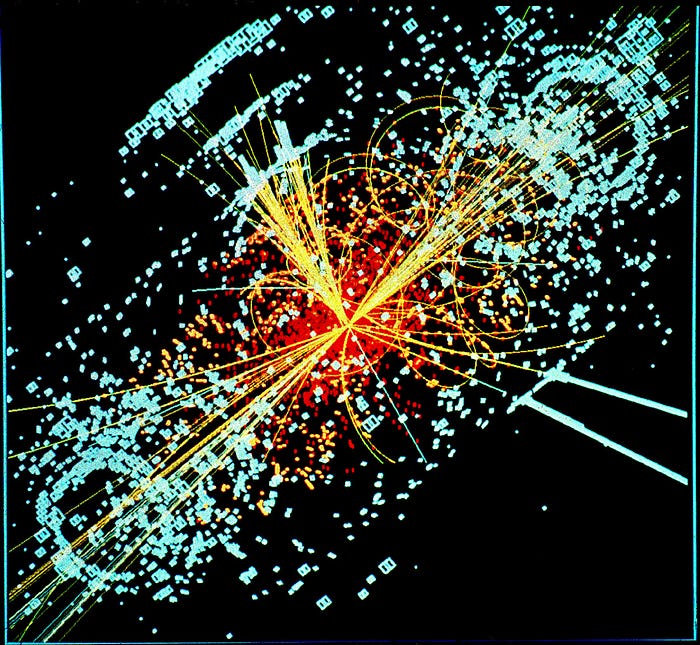
The Higgs boson, a fundamental particle in the Standard Model, was theorized in 1964 by Peter Higgs and others to explain the origin of mass through the Higgs field. Its discovery on July 4, 2012, by the ATLAS and CMS experiments at the Large Hadron Collider (LHC) at CERN marked a significant milestone in particle physics, confirming a key prediction and earning Nobel Prizes for Higgs and François Englert in 2013. Detecting the Higgs boson, however, remains challenging due to its low production cross-section in proton-proton collisions (approximately 300 Higgs bosons per 10¹¹ collisions per hour at the LHC) and the presence of overwhelming background processes, such as top quark pair production (tt̄) or W+jets events, which mimic Higgs decay signatures.
Machine learning (ML) has become indispensable in high-energy physics for enhancing the sensitivity of Higgs boson searches. By analyzing vast datasets from particle detectors, ML algorithms can identify subtle patterns that indicate Higgs boson production, improving the signal-to-background ratio. This survey note explores the application of ML in Higgs boson detection, focusing on the important data features and their connection to underlying physics, as well as recent advances and ongoing debates.
Dataset and Important Data Features
The detection process relies on collision data recorded by experiments like ATLAS and CMS, often analyzed using simulated datasets due to the rarity of signal events. A prominent example is the HIGGS dataset from the UCI Machine Learning Repository , which contains 11 million instances generated via Monte Carlo simulations. Each event is described by 28 features, plus a binary label (1 for signal, 0 for background), totaling 29 columns. These features are categorized into:
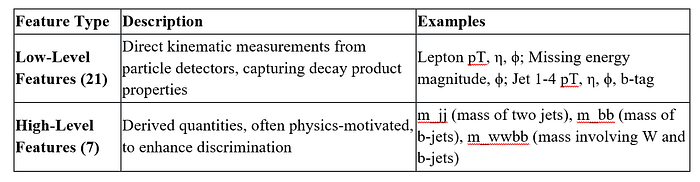
- Low-Level Features: These include:
- Lepton properties: Transverse momentum (pT), pseudorapidity (η = -ln[tan(θ/2)]), and azimuthal angle (ϕ) for charged leptons (electrons or muons), which are decay products of W or Z bosons in Higgs decay chains like H → WW* → ℓνℓν.
- Missing transverse energy: Magnitude and ϕ, indicating undetected particles like neutrinos, crucial for decays involving W bosons.
- Jet properties: For up to four jets, pT, η, ϕ, and b-tagging (a probabilistic score indicating if the jet originates from a b-quark). Jets are collimated sprays from quark or gluon fragmentation, and b-tagging is particularly relevant for Higgs decays like H → bb, given the Higgs boson’s significant branching ratio to b-quarks.
- High-Level Features: These are functions of the low-level features, designed to reconstruct physical quantities:
- Invariant masses: e.g., m_jj (invariant mass of the two leading jets), m_bb (mass of b-tagged jets), which can peak at the Higgs mass (approximately 125 GeV/c²) for signal events.
- Other combinations: e.g., m_lv (mass of lepton and missing energy, approximating the W boson mass), m_jlv (mass involving lepton, jets, and missing energy), m_wbb, m_wwbb, which help in identifying resonance structures.
These features are critical for distinguishing Higgs signal events from backgrounds. For instance, the m_bb distribution may show a peak at 125 GeV for H → bb, while backgrounds like tt̄ have a broader, falling distribution. The choice of features reflects the physics of Higgs decays, which can involve leptons (from W or Z), jets (especially b-jets), and missing energy (from neutrinos).
Machine Learning Techniques for Higgs Boson Detection
ML techniques have been extensively applied to classify Higgs boson events, leveraging the high-dimensional feature space. Common methods include:
- Neural Networks: Multi-layer perceptrons (MLPs) and deep learning architectures have been benchmarked on the HIGGS dataset, with 5-layer neural networks achieving notable performance. Recent advances include graph neural networks (GNNs) for analyzing jet substructure or event-level graphs, where particles are represented as nodes connected by edges based on spatial proximity.
- Ensemble Methods: Decision trees, random forests, and gradient boosting machines (e.g., XGBoost) are popular for handling class imbalance, a common issue in Higgs detection due to the rarity of signal events. A study using the HIGGS dataset reported XGBoost achieving 74% accuracy, demonstrating its effectiveness .
- Unsupervised Learning: Techniques like autoencoders are used for anomaly detection, identifying events that deviate from background distributions. A recent paper explores using autoencoders trained on Standard Model (SM) Monte Carlo events to calculate loss distributions, aiding in detecting anomalies that could indicate di-Higgs production.
- Other Methods: Support vector machines and Bayesian decision trees have also been applied, with performance metrics like area under the receiver operating characteristic curve (AUC) or discovery significance used for evaluation.
Models are typically trained on Monte Carlo simulations, which model both signal (e.g., gg → H → WW* → ℓνℓν) and background processes (e.g., tt̄, W+jets). The training process involves optimizing the model’s ability to separate signal from background, often using cross-validation and addressing class imbalance with techniques like SMOTE (Synthetic Minority Over-sampling Technique).
Physics Insights and Integration with Machine Learning
The integration of ML with Higgs boson detection offers unique insights into the underlying physics. Traditional analyses often rely on cut-based methods or manual feature engineering, such as selecting events with m_bb near 125 GeV. ML, however, can learn complex, non-linear correlations in the data, potentially uncovering patterns not captured by physics-motivated features.
- Feature Learning vs. Physics-Based Features: There is an ongoing debate in the field about the balance between using physics-based high-level features (like invariant masses) and letting ML models learn from low-level, raw data. Physics-based features provide interpretability, connecting model decisions to known processes (e.g., Higgs mass resonance), while data-driven approaches can discover new discriminative patterns. Recent studies suggest deep learning can improve classification metrics by 8% over traditional methods without manual feature engineering (Searching for Exotic Particles).
- Handling Backgrounds: ML excels at distinguishing signal from complex backgrounds by learning subtle differences in kinematic distributions. For example, the m_wwbb distribution may differ between H → WW* → ℓνℓν and W+jets backgrounds, and ML can capture these differences more effectively than simple cuts.
- Recent Advances: The paper on di-Higgs searches highlights the use of anomaly detection, complementing supervised learning. This approach is particularly promising for rare processes, where traditional supervised methods may struggle due to limited training data.
Challenges include ensuring model generalization across different simulation environments (e.g., PYTHIA vs. HERWIG) and addressing biases in synthetic data. Techniques like VICReg (Variance-Invariance-Covariance Regularization) have been explored to mitigate overfitting to simulation artifacts, enhancing robustness.
Conclusion and Future Directions
Machine learning has significantly enhanced Higgs boson detection by improving the sensitivity of signal-versus-background classification, leveraging key data features like lepton and jet kinematics and derived masses. Techniques ranging from neural networks to ensemble methods and recent advances in anomaly detection have demonstrated their efficacy, with ongoing research exploring graph neural networks and unsupervised learning for rare processes like di-Higgs production.
As the LHC continues to operate with increasing luminosity, generating larger datasets, the integration of advanced ML techniques will be crucial. Future directions include developing interpretable models that balance performance with physics insights, addressing simulation biases, and exploring generative models for data augmentation. This interdisciplinary approach promises to push the boundaries of discovery in particle physics, potentially uncovering new physics beyond the Standard Model.
Notation Clarifications:
- tt̄: Top quark (t) and anti-top quark (t̄) pair.
- W+jets: Events with a W boson and additional jets.
- H → WW → ℓνℓν: Higgs decay to two W bosons (one off-shell, denoted WW), then to leptons (ℓ) and neutrinos (ν).
- H → bb: Higgs decay to a bottom quark (b) and anti-bottom quark (b̄) pair.
- MET: Missing Transverse Energy, replacing “missing transverse energy” for clarity.