International student migration has existed for many years, and in 2026 it remains a rapidly growing global phenomenon. In the 2025/26 academic year, German universities alone enrolled about 420,000 international students and doctoral candidates, which represented roughly a 4% increase compared with the previous year and continued a decade‑long pattern of growth. Within this group, about 99,000 were first‑time foreign students, an increase of around 9% year‑on‑year, showing that new inflows of international students are still strong. India is currently the largest single source country for Germany, with roughly 59,000 Indian students enrolled, making up a significant part of the international student body and illustrating the scale of contemporary student mobility.
Throughout this history and up to 2026, various protective institutions and support systems have been established to help students adapt, succeed, and remain safe while studying abroad. Recent survey work on international students in Germany and other host countries has highlighted recurring challenges such as language barriers, financial pressure, residence and visa procedures, and emotional stress, all of which increase the importance of strong institutional support for foreign students.
Today, we will explore what institutional protection means for international students and why these support structures are important.
When students migrate to a foreign country for education, it is generally hoped that they will return home with greater knowledge, skills, and opportunities than they had before. In major host countries like Germany, where foreign students now form a sizeable share of all university enrolments, international graduates are seen as important both for the students’ home countries and for the host country’s labour market and research system. However, studying abroad can also expose students to unfamiliar social, cultural, legal, and personal challenges, ranging from different classroom expectations to new legal rules for work and residence.
As students navigate a new environment, they often become more independent and exploratory in their decisions. While this can contribute positively to personal growth, it can also disrupt academic plans or place students in unforeseen situations. The purpose of protective institutions is to support students during this period, helping them stay focused on their educational goals while providing guidance when difficulties arise. In recent years, for example, universities and governments have responded to crises such as the COVID‑19 pandemic and changing migration policies by expanding counselling services, information campaigns, and emergency assistance aimed specifically at international students.
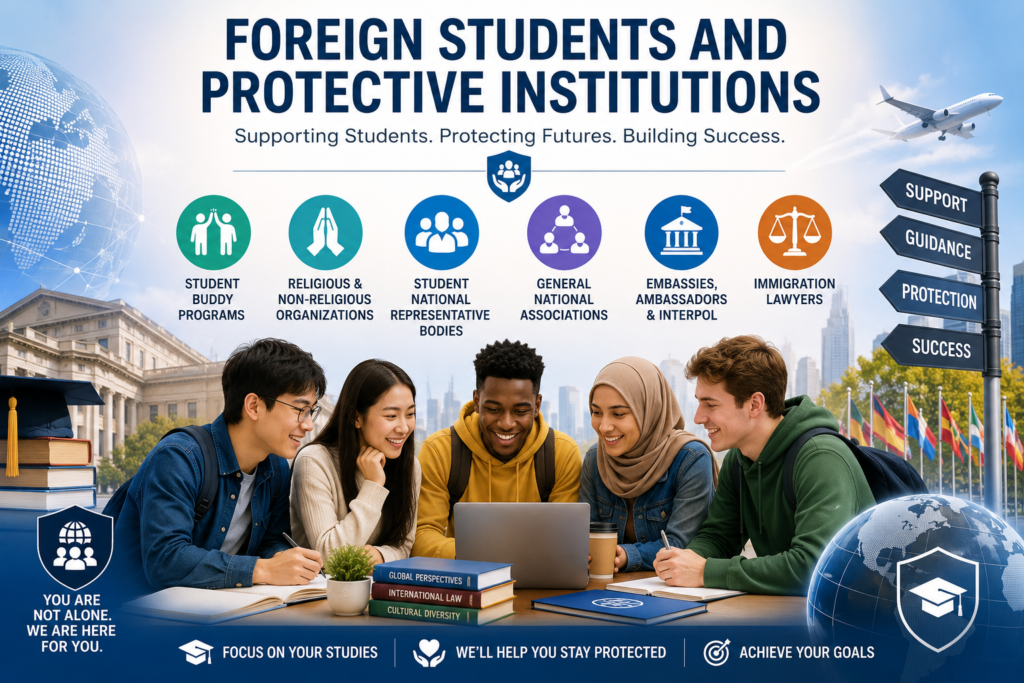
Examples of Protective Institutions
- Student Buddy Programs
- Student Religious and Non-Religious Organizations
- Student National Representative Bodies in the Host Country
- General National Associations and Community Organizations
- Embassies, Ambassadors, and International Law Enforcement Cooperation (e.g., Interpol)
- Immigration Lawyers
These structures work alongside formal university services such as international offices, student welfare organisations, and counselling centres, which in many countries now provide free or low‑cost support in areas like academic skills, mental health, housing, and legal issues for international students.
Student Buddy Programs
A student buddy program is one of the most valuable support systems available to international students. A student buddy is typically a volunteer or employed student who helps guide new international students through their academic and social transition. Many universities in Europe and beyond now advertise buddy or mentoring programmes for international students as a standard part of their support offering, especially during the first semester.
Student buddies are often:
- Familiar with the institution and local environment.
- High-performing students in a similar field of study.
- From the same country, region, or cultural background as the new student, or at least experienced in intercultural settings.
- Trained and registered through official university support programs.
Their role is to help new students adjust, understand university processes, and overcome common challenges during their studies. In practice, this can include support with course registration, exam formats, online systems, local transport, basic bureaucratic processes such as city registration, and informal advice on social and cultural norms in the host country.
Student Religious and Non-Religious Organizations
Religious and non-religious student organizations provide community, belonging, and personal support. They help students maintain their values and identity while adapting to a new environment. At many universities, there are student groups linked to specific faiths, humanist or secular organisations, and intercultural friendship groups designed to help international and local students meet in a structured way.
These organizations can:
- Offer emotional and social support at times of stress, homesickness, or culture shock.
- Create opportunities for friendship, social events, and networking with peers who share similar values or interests.
- Provide guidance during difficult periods, sometimes in cooperation with university chaplaincy services or counselling centres.
- Help students develop a sense of purpose and belonging in a foreign country through shared activities, volunteering, and discussion groups.
Student National Representative Bodies
Student national bodies have long served as important support organizations for international students. These groups are often formally registered in the host country and represent students from a particular nation or region. In Germany and other major host countries, there are national student associations for many large sending countries, reflecting the scale of their student communities—for example, India as the largest single source country for Germany in the mid‑2020s.
Their responsibilities may include:
- Organizing student activities and cultural events that showcase their home country’s traditions.
- Promoting educational opportunities, scholarships, and information about both home and host‑country programmes.
- Advocating for student welfare and interests in dealings with universities, embassies, or local authorities.
- Building academic and professional networks among students and recent graduates in similar disciplines.
General National Associations
General national associations are important community organizations for many international students. They often serve as a bridge between students and the broader diaspora community in the host country. In a context where hundreds of thousands of international students live in countries like Germany, France, Canada, and the United States, these diaspora networks are increasingly diverse and professionally connected.
These organizations may:
- Share news and developments from the home country, including political events, scholarship schemes, and labour market trends.
- Promote cultural and community engagement through festivals, language courses, or public events.
- Connect students with experienced professionals from their home country who have settled in the host country.
- Provide mentorship and career-development opportunities, such as internship leads, CV workshops, and networking evenings.
Such support is especially valuable when professionals in the network work in the same field as the student, for example engineering, information technology, business, or health sciences, which are among the most popular areas of study for international students in many host countries.
Embassies, Ambassadors, and International Cooperation Agencies
Embassies play a vital protective role for citizens studying abroad. They are often the primary point of contact during emergencies, national crises, legal difficulties, or situations requiring consular assistance. With hundreds of thousands of students abroad from individual countries, embassies regularly handle issues such as lost passports, detention, sudden illness, or crises that affect groups of citizens in the host country.
Embassies can:
- Provide consular support and guidance, including information on local legal systems, emergency contacts, and travel advice.
- Assist in emergencies involving citizens abroad, such as serious accidents, natural disasters, or political unrest.
- Help with lost passports and travel documents and issue temporary papers when necessary.
- Communicate important information during national or regional crises via websites, social media, or direct contact lists.
- Connect students with appropriate local resources, including lawyers, translators, or social services where needed.
Ambassadors and embassy staff represent the interests of their home country and its citizens overseas. In some cases, international cooperation between law enforcement and consular services, including the use of shared databases and alerts, can become relevant when there are cross‑border legal or security matters involving foreign students.
Immigration Lawyers
Immigration lawyers help students understand and comply with immigration laws and visa requirements in their host countries. In Germany, for example, current guidance for 2025/26 explains that non‑EU students with a residence permit for study purposes are normally allowed to work up to 140 full days or 280 half days per year, and after successfully completing their studies they can apply for a job‑seeker residence permit of up to 18 months to find qualified employment. From there, recent policy discussions in 2026 emphasize faster and clearer pathways to long‑term residence for skilled graduates who secure qualified jobs, as part of efforts to attract and retain international talent.
Immigration lawyers can provide guidance on:
- Student visa applications and renewals, including required financial proof and insurance.
- Work authorization rules and limits, such as maximum hours, type of employment, and taxation.
- Residency and immigration matters, especially when students wish to change status (for example, from student to skilled worker).
- Legal rights and responsibilities in the host country, including protection against exploitation in work settings or discrimination in housing.
Professional legal advice can be especially important when students face complex immigration or legal challenges, such as delayed residence permits, confusion about changing rules, or disputes with employers or landlords. Universities and student services in countries like Germany often complement this with free or low‑cost legal counselling sessions for students through student welfare organisations and legal advice offices.
Conclusion
Protective institutions play a critical role in the success and well-being of international students in 2026. Current enrolment data show that international student numbers continue to grow in major host countries, while research and policy discussions highlight ongoing challenges related to finance, language, mental health, and legal status. From student buddies and community organizations to embassies, legal professionals, and government information campaigns, these support systems help students adapt to new environments, overcome difficulties, and remain focused on achieving their educational goals.
By making use of these resources, international students can have a safer, more productive, and more rewarding study experience abroad. Early contact with international offices, student welfare organisations, and trusted legal or consular services can prevent small issues from developing into serious crises and can also open doors to academic, professional, and personal opportunities that might otherwise remain hidden.