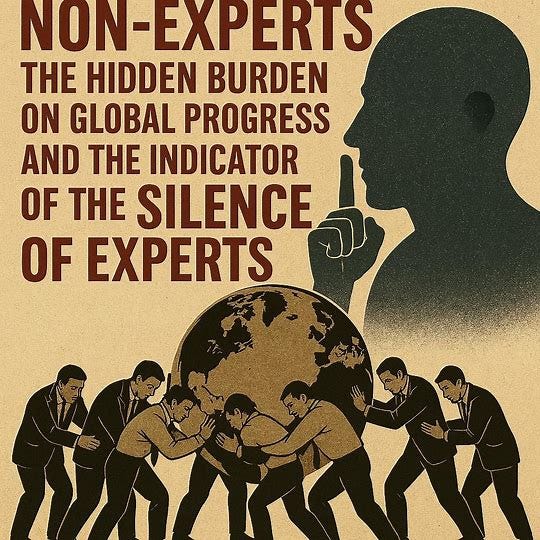
“One of the most basic reasons experts and laypeople have always driven each other crazy is because they’re all human beings. That is, they all share similar problems in the way they absorb and interpret information. The death of expertise is not just a rejection of existing knowledge. It is fundamentally a rejection of science and dispassionate rationality, which are the foundations of modern civilization. This trend is endangering modern society and democracy, as it erodes public trust in reliable expert knowledge.”
— Tom Nichols, The Death of Expertise: The Campaign Against Established Knowledge and Why It Matters
From the Deepwater Horizon Oil Spill in North America, where cost-cutting decisions overrode engineering expertise, to the Mariana Dam collapse in South America, where repeated warnings from geotechnical engineers were ignored, the world has seen the consequences of sidelining experts. In Europe, the Chernobyl disaster revealed the catastrophic results of operators disregarding reactor design warnings, while in Africa, political leaders ignored intelligence and expert advice that might have prevented the Rwandan genocide. In Asia, the Bhopal gas tragedy tragically demonstrated the human cost of neglecting chemical safety expertise, and in Australia, the Black Saturday bushfires highlighted the dangers of ignoring fire science and land management advice. Even in the remote expanses of Antarctica, early research mismanagement caused lasting environmental contamination due to the dismissal of scientific guidance. And even historically, the Salem Witch Trials and the rise of Nazism show that ignoring expert warnings in matters of law, politics, and social policy can lead to hysteria, injustice, and catastrophic human loss. Across every continent and every century, these disasters reveal a common lesson: when non-experts dominate critical decisions and expertise is disregarded, preventable tragedies become inevitable.
Note: This story is not part of a series, but it will be continuously updated as I refine it and incorporate feedback from critics. In the meantime, feel free to like, comment, share, and spread this work wherever you find it as your engagement helps shape its evolution.
This topic has always weighed on my heart as I move through life. Those close to me know I can be fiercely critical, always questioning and analyzing. Growing up, I discovered three lessons that shaped how I see the world:
The first came from an introductory technology class teacher. “If you use the wrong tool for a problem, you risk harming yourself and others”. It was simple, yet it taught me the importance of precision and the right approach. The second lesson came from documentary opening about disasters. “Disasters don’t just happen, they’re a chain of critical events. Unravel those faithful decisions in the final, Seconds from Disaster! ”.
The third lesson came a military personnel of high rank and intellect, it was the hardest to swallow. “Whatever your professor tells you to do in their subject matter, do it with total submission to their guidance”. At first, it felt like a blow to one’s independence, but over time I realized the value in learning from those with deeper experience. These lessons, sometimes painful, sometimes humbling, have stayed with me and continue to shape how I approach knowledge, expertise, and life itself.
The world today is drowning in the noise of non-experts. Everyone has an opinion, and most broadcast it as life advice, backed by nothing more than their invisible authority figure or their own self-assured authority. From their own God came fanaticism; from ‘speak your own truth’ came relativism. Together, they have birthed Ignorance 2.0, amplified exponentially by AI and social media. The result is a flood of misinformation, distraction, and confusion. It so pervasive that sometimes the only relief is to unfollow, block, and seek spaces where expertise still matters. Perhaps the future will demand that credentials be visible and renewable, a filter against the deluge of the uninformed.
It is entirely okay to talk about a subject you are not an expert in, as long as you do not claim authority over it. In fact, it can be valuable to share your perspective, so long as you acknowledge your limits and invite expert insight to challenge or refine your understanding. For instance, you might give an overview of a topic you know little about, then cite an expert source to correct or expand your view.
Having explored what non-expert looks like ranging from everyday misinformation to amplified non-expert noise. we are now ready to turn to the other side of the spectrum: what defines an expert and how true expertise can be recognized, verified, and applied in society.
Who is an expert:
An expert is defined as an individual who has a combination of advanced, coherent knowledge, empirical grounding, practical relevance, proven mastery, continuous professional development, and the ability to communicate insightfully and engage in critical dialogue in their profession or subject matter
An expert is a person whose knowledge and skills form a logically coherent system, are supported by empirical evidence, and remain relevant to lived human experience. Their claim to expertise is sustained by continuous and renewable licensing, verified track records, and accountability to professional and societal standards. An expert does not merely preserve knowledge but continually pushes the frontier of their domain, earning recognition and remuneration commensurate with the value they create for society. Moreover, an expert demonstrates mastery by communicating their insights with clarity: able to explain them to a child in simple terms, to peers in precise detail, and to those with greater expertise without confusion or distortion. Finally, an expert creates intentional space for dialogue and welcomes challenge, knowing that genuine knowledge grows stronger when tested by openness, critique, and collaboration.
Yes, my definition may read like a tapestry of familiar terms, yet each thread matters: the test of truth, relentless learning, training and evaluation like an AI model, valuing what is truly gold, honoring freedom of speech, standing on the shoulders of giants, and remembering the Kruger effect that humbles even the confident.
I have carefully framed this definition of an expert to avoid creating a cult of dogma, reinforcing confirmation bias, or neglecting outliers whose insights might challenge conventional wisdom.
So what about those moments of divine inspiration, intuition, hunches, or gut feelings? These often emerge from continuous exposure to theoretical knowledge and experiential learning. Over time, they resurface precisely when you need them most. A physics protégé did not suddenly wake up at age three and start solving calculus. He began with 1 + 1, gradually tackling increasingly challenging problems. When you stop pushing yourself to confront the next challenge, the music stops, and the flow halts. What differentiates one protégé from another is how quickly and accurately they can master each step with minimal error.
By cultivating such a structure of accountable, communicable expertise, one can build systems and institutions that are efficient, resilient, and capable of sustaining a functioning society.
AI and Expertise:
Artificial Intelligence is transforming the job market by automating routine or “dead-end” jobs and pushing professionals toward specialized niche expertise. If you don’t focus on developing deep, niche skills, you risk being left behind and becoming irrelevant in today’s competitive job landscape. This is a time to shed unnecessary distractions and concentrate on cultivating unique expertise.
How do I know this? Besides having free access to advanced AI models, I work closely with engineers, training them and frankly, we are not prepared for what’s coming. Over nine months, I have been training AI models on advanced physics. The goal isn’t for the AI to pass the training immediately but to fail and require retraining, mimicking the learning curve of a human scientist. These models were trained on cutting-edge physics research and instructed to answer like everyday practicing scientists, this model aren’t trained on prompts but image of a physics experiment in a laboratory setup . The key advice I can offer in this AI-driven era is to become a niche expert. Don’t waste time on superficial knowledge or broad generalizations. Since the AI boom, many companies believed they could solve problems by cutting their expert workforce. However, successful AI implementation demands deep, specialized expertise. Instead of layoffs, many organizations have had to rehire experts and intensify their training programs. In short, niche expertise is now more valuable than ever to thrive alongside AI.
I will pause here for now, but I encourage readers to explore the books referenced and follow along, as I will continue to refine this write-up weekly. In future installments, we will examine topics such as the standardization of recognizing experts, the relationship between expertise and the dangers of meritocracy, the connection between experts and systems thinking, the bureaucracy of continuous licensing, the challenges and exploitation along the journey of becoming an expert, and the role of lobbyists and non-experts, as well as channels to guide or redirect them.
Let therefore make it a duty to surround yourself with experts and critics of your expertise in your subject area and always create space for lectures, rigorous debate, and intellectual challenge. True expertise thrives not in isolation, but in dialogue that tests, refines, and strengthens knowledge.
Attached are 10 books on this topics:
- Plato — The Republic (philosophical reflection on the rule of knowledge vs. ignorance).
- John Stuart Mill — On Liberty (debates the value of opinion, even wrong ones).
- José Ortega y Gasset — The Revolt of the Masses (classic critique of mass society overpowering expertise).
- C. Wright Mills — The Power Elite (on how authority and decision-making clash with the uninformed masses).
- Neil Postman — Amusing Ourselves to Death (media-driven decline in rational discourse).
- Nicholas Carr — The Shallows (how the internet reshapes thought — shallow expertise).
- Tom Nichols — The Death of Expertise (direct attack on the cult of non-experts).
- Susan Jacoby — The Age of American Unreason (ignorance and anti-intellectualism in modern society).
- Jonathan Swift — A Modest Proposal (satirical masterpiece — model for irony and wit).
- Voltaire — Candide (philosophical satire exposing foolish optimism and uninformed certainty).
Until Next time , see you again……..