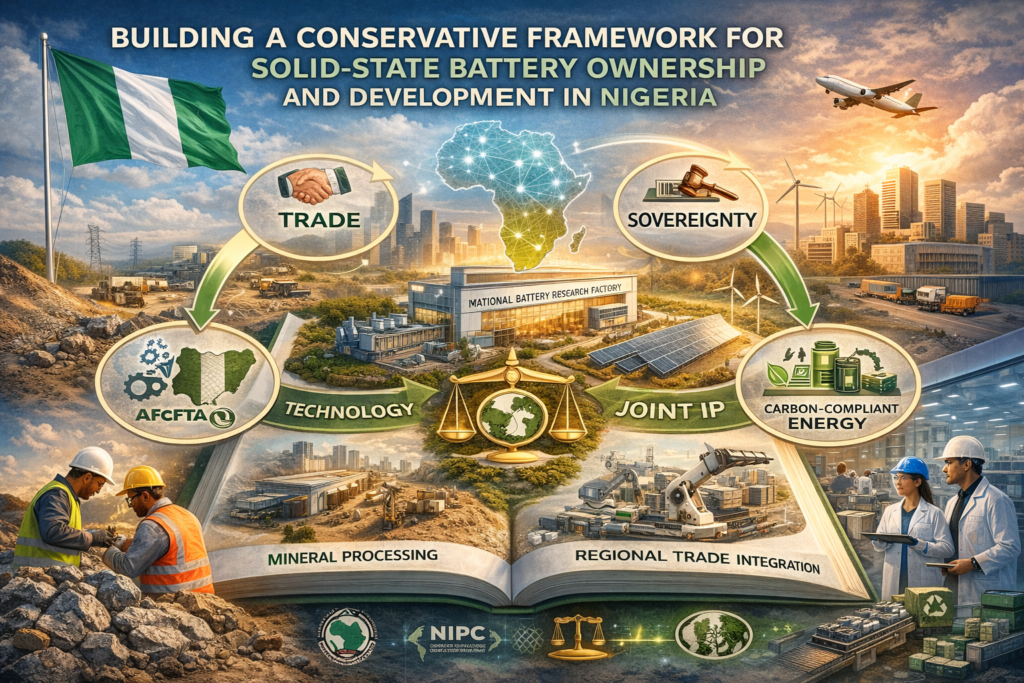
Building Nigeria’s Conservative Path to Solid-State Battery Leadership
The global race for next-generation batteries is accelerating, and solid-state batteries (SSBs) are at the center of it. From electric vehicles to grid storage, countries are investing billions to secure supply chains, intellectual property, and manufacturing capabilities.
For Nigeria, the opportunity is realbut the path forward does not need to be reckless or rushed.
Instead, Nigeria can build a conservative but forward-looking battery development model: one that prioritizes domestic ownership, technology transfer, and sustainable production while gradually scaling industrial capacity.
The goal is simplemove beyond exporting minerals and begin shaping the technologies that use them.
The Strategic Lens: Trade, Sovereignty, and Sustainability
At the heart of Nigeria’s potential battery strategy lies what could be described as a “3S Convergence”: Trade, Sovereignty, and Sustainability.
Trade comes from leveraging the African Continental Free Trade Area (AfCFTA) to build regional battery value chains. Rather than exporting raw lithium, Nigeria could supply processed materials and battery components across Africa’s growing clean-energy markets.
Sovereignty means ensuring that the knowledge, patents, and engineering expertise behind battery technologies are not entirely controlled abroad.
Sustainability ensures that Nigeria’s battery industry is compatible with emerging global carbon standards, particularly those shaping access to European and international markets.
When these three elements align, the result is not just industrial growthit is strategic control over an emerging technology sector.
Closing the “Lab-to-Factory” Gap
Nigeria’s lithium sector is already expanding rapidly.
Large processing plants in Nasarawa State, including facilities in Lafia, are beginning to establish a midstream lithium industry capable of feeding advanced battery production. But experience from other countries shows that processing minerals alone is not enough.
Several high-profile battery ventures in Europe struggled because they lacked a strong bridge between scientific research and industrial manufacturing.
Nigeria can avoid this by building a National Battery Research Factorya shared research and pilot manufacturing center similar to Germany’s industrial battery research facilities.
Such an institution would connect university laboratories to industrial pilot lines, allowing researchers, startups, and manufacturers to test materials, processes, and production techniques before scaling into large factories.
In short, it would transform research ideas into real manufacturing capability.
Strengthening the Industrial Base
Beyond processing, another critical pillar is recycling.
Battery recycling facilities emerging in Ogun State are expected to recover valuable materials from lithium-ion and lead-acid batteries, creating the foundation for a circular battery economy in West Africa.
Recycling does more than reduce wasteit ensures that valuable minerals stay within the domestic industrial system, lowering future dependence on imports.
Combined with lithium processing in Nasarawa, Nigeria could quietly assemble one of Africa’s most complete battery material ecosystems.
Technology Transfer and Joint Innovation
Foreign investment will remain essential in building this industry. But investment alone does not guarantee long-term national benefit.
Nigeria already operates an investment framework through the Nigerian Investment Promotion Commission (NIPC) that allows foreign participation while encouraging local capacity development.
The next step is ensuring that major battery projects include structured technology transfer and joint intellectual property development.
Under Nigeria’s Patents and Designs Act, joint patent ownership between Nigerian and foreign partners is possible. When structured carefully, this allows both parties to share innovation while preventing critical technologies from being completely controlled outside the country.
In practical terms, this means battery materials, manufacturing processes, and system designs developed in Nigeria could remain partially owned and accessible to domestic companies.
Building a Continental Battery Network
Nigeria’s battery future will not exist in isolation.
AfCFTA is already enabling cross-border battery trade across Africa. A natural next step could be a Pan-African battery collaboration, linking countries with complementary strengths.
Nigeria could lead on lithium and sodium-based chemistries.
South Africa could contribute advanced precursor materials and industrial research.
Ethiopia could expand assembly capabilities.
Morocco could support export logistics and global market access.
Together, these capabilities could form a distributed African battery ecosystem capable of competing globally.
Preparing for the Carbon Economy
The future battery market will also be shaped by carbon regulations.
As regions like Europe introduce carbon border adjustments and stricter environmental standards, manufacturers will need to prove that their batteries are produced with low-emission energy systems.
Nigeria is already participating in emerging African carbon market frameworks, which could support monitoring and verification systems for green industrial projects.
By powering battery industrial parks with renewable micro-grids and transparent carbon accounting systems, Nigeria could position its battery exports as low-carbon and globally compliant.
A Conservative but Powerful Strategy
The smartest industrial strategy for Nigeria may not be the fastestbut the most deliberate.
A conservative development pathway would prioritize:
• Domestic mineral processing before export
• Structured technology transfer in major investments
• Shared research infrastructure for scaling battery technologies
• Gradual gigafactory development tied to renewable energy growth
• Regional battery trade under AfCFTA
If aligned with Nigeria’s growing critical minerals investments and emerging carbon market infrastructure, this approach could quietly position the country as Africa’s leading hub for solid-state and next-generation battery technologies by the early 2030s.
The minerals already exist.
The investments are beginning.
The real question now is whether Nigeria can build the institutions that turn resources into long-term technological leadership.